
30 April 2026
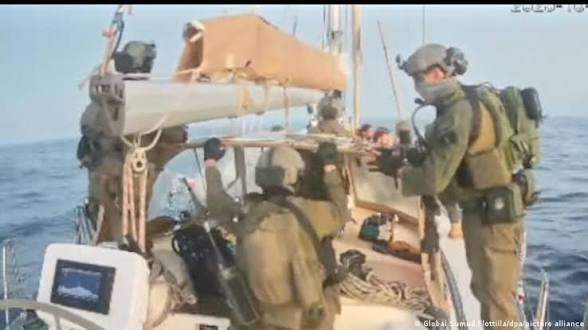
The interception of the Global Sumud Flotilla by the Israel Defense Forces has reignited international scrutiny over the boundaries of maritime law, with legal experts and governments divided over whether the operation in international waters constitutes a violation of established legal norms. The flotilla, composed of civilian vessels carrying humanitarian aid and activists, was en route to the Gaza Strip when Israeli naval forces moved to intercept it before it could reach its destination.
According to reports, the operation took place outside Israel’s territorial waters, a detail that has become central to the legal controversy. Under the framework of the United Nations Convention on the Law of the Sea, ships navigating international waters are generally protected under the principle of freedom of navigation. This principle limits the ability of states to interfere with foreign vessels unless under exceptional circumstances such as piracy or threats to security that are clearly defined under international law. Critics of the interception argue that the flotilla did not meet these exceptions, as it consisted of civilian ships and was publicly declared as a humanitarian mission.
Activists involved in the flotilla have condemned the interception as an unlawful act, asserting that boarding civilian vessels in international waters amounts to a breach of maritime law. Some have gone as far as to describe the operation as an act comparable to piracy, though such terminology remains contested in formal legal discourse. Organizers insist that the cargo consisted of essential humanitarian supplies, including food and medical aid, intended to alleviate conditions in Gaza, where access to resources remains tightly controlled.
Israel, however, has defended the operation by pointing to a different legal justification rooted in the laws of armed conflict at sea. Officials argue that the naval blockade imposed on Gaza since 2007 is a legitimate security measure aimed at preventing the flow of weapons to Hamas, which governs the territory. Under guidelines such as the San Remo Manual on International Law Applicable to Armed Conflicts at Sea, a state engaged in conflict may enforce a naval blockade beyond its territorial waters, including in international seas, provided that the blockade is declared, effectively maintained, and does not deliberately block humanitarian assistance to civilians.
This clash between two legal interpretations has created a complex and unresolved debate. On one hand, the principle of free navigation under maritime law appears to restrict interference with civilian vessels in international waters. On the other, the legal framework governing naval warfare allows for enforcement measures that extend beyond national jurisdictions during times of conflict. The key question remains whether the blockade itself meets international legal standards and whether its enforcement, in this case, was proportionate and justified.
Legal analysts note that similar incidents involving Gaza-bound flotillas in the past have produced no clear international consensus, leaving each new confrontation open to interpretation. The lack of a definitive ruling from an authoritative international legal body has contributed to ongoing uncertainty, with states often aligning their positions along political lines rather than strictly legal ones. Human rights organizations have called for independent investigations into the incident, emphasizing the need to clarify the legal boundaries governing such operations.
The situation also raises broader concerns about humanitarian access. International law requires that civilian populations must not be deprived of essential goods, even during blockades. Critics argue that repeated interceptions of aid missions could undermine these protections if alternative delivery channels are insufficient or heavily restricted. Israel maintains that aid can enter Gaza through regulated crossings and ports where inspections are conducted, but humanitarian groups continue to question whether these mechanisms are adequate to meet the needs of the population.
As the debate continues, the interception of the Global Sumud Flotilla underscores a deeper tension between security policies and international legal norms. With no universally accepted resolution in sight, the incident highlights the fragile balance between enforcing military objectives and upholding the principles of maritime law in international waters, a balance that remains as contested as the conflict itself.
Leave a Reply