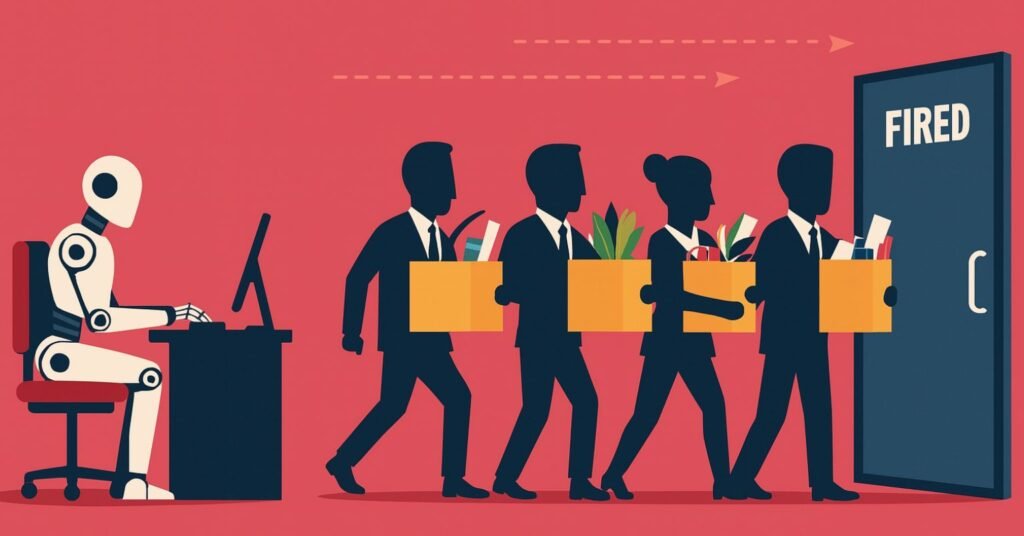
A recent court decision in China has drawn global attention after ruling that companies cannot dismiss employees solely on the grounds that their work has been replaced by artificial intelligence systems. The case reflects a growing tension between rapid technological adoption and the legal and social frameworks that govern employment.
The core issue in the case was not whether artificial intelligence can perform human tasks, but whether efficiency gains from automation can justify immediate termination of workers without proper restructuring procedures. The court sided with the employee, stating that automation alone does not constitute a lawful reason for dismissal. Companies are expected to follow formal labour procedures, including reassignment of roles, retraining, or compensation where necessary.
This decision highlights a deeper global challenge. Artificial intelligence is no longer a future concept. It is already embedded in customer service, finance, logistics, media, and even legal work. As systems become more capable, businesses are naturally incentivised to reduce operational costs by replacing repetitive human roles with automated tools. However, the legal systems in many countries were not designed for a labour market where machines can directly substitute human workers at scale.
In Asia, particularly in emerging economies, the situation is even more complex. Many countries are aggressively adopting artificial intelligence to improve productivity and attract investment. However, labour protection laws in several of these economies are still evolving and often do not explicitly address AI driven job displacement. This creates a grey area where companies may restructure aggressively under the justification of efficiency without clear safeguards for workers affected by automation.
In Southeast Asia, this issue is becoming increasingly relevant. Governments are encouraging digital transformation across industries, but the pace of regulation is slower than the pace of technological adoption. As a result, companies may gradually reduce hiring in roles that are highly automatable, such as administrative support, basic data processing, and customer interaction services. Rather than immediate mass layoffs, the more common pattern may be hiring freezes and gradual role elimination, which can be less visible but equally impactful over time.
In developed economies such as the United States and parts of Europe, the response is different. There is growing pressure from regulators, labour unions, and policymakers to ensure that artificial intelligence does not lead to uncontrolled displacement of workers. Discussions around accountability, retraining obligations, and ethical deployment of automation are becoming central to policy debates. The focus is shifting from whether AI should be used to how it should be implemented responsibly within society.
The broader implication of the Chinese court ruling is not that artificial intelligence will be restricted, but that societies are beginning to define boundaries around its economic impact. The legal reasoning suggests an emerging principle that technological progress alone cannot override labour rights and procedural fairness.
At the same time, businesses are unlikely to slow down their adoption of AI. The economic advantages are too significant to ignore. Instead, the likely direction globally is a gradual balancing act between innovation and regulation. Companies will continue to automate, but they may be required to demonstrate structured workforce transitions rather than abrupt replacements.
The most important question moving forward is not whether artificial intelligence will replace jobs, but how quickly societies can adapt their legal, educational, and economic systems to manage that transition. Countries that succeed in balancing innovation with worker protection may experience smoother transformation, while those that lag behind risk higher social and economic disruption.
Ultimately, artificial intelligence is reshaping the definition of work itself. The challenge for governments and businesses is not to resist this change, but to ensure that the transition does not leave large segments of the workforce without support or opportunity in the new economy.
Leave a Reply