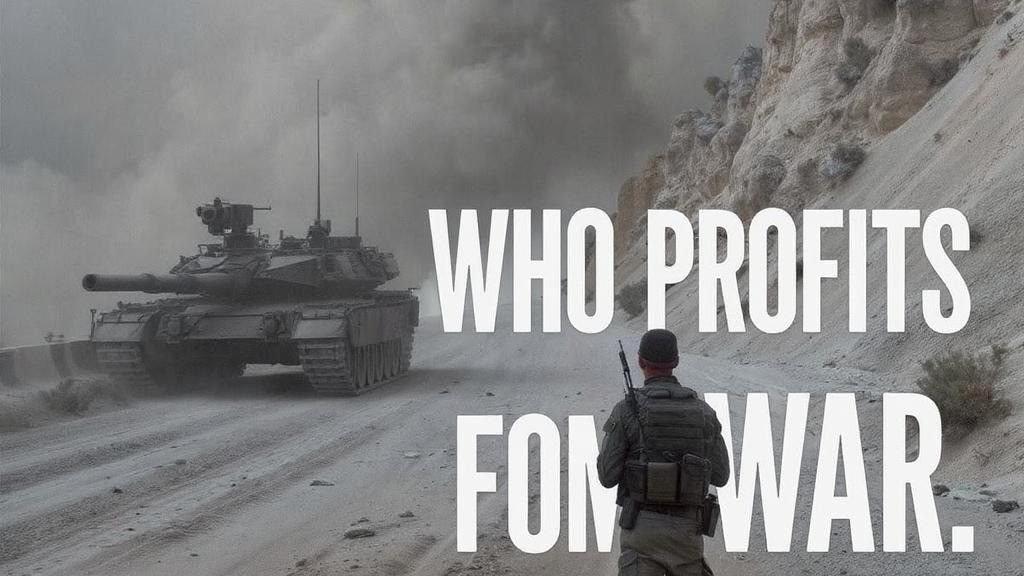
Global military expenditure reached $2.72 trillion in 2024, marking the steepest annual increase since the Cold War (Stockholm International Peace Research Institute [SIPRI], 2025). Over the past decade, spending has grown by 37%, highlighting a structural pattern: war is not merely reactive, but embedded within the global economic system.
Militarization as Structural Violence
Resources allocated to defense come at the expense of social sectors such as healthcare, education, and climate initiatives. Vulnerable populations disproportionately bear these costs, reflecting how militarization operates as a form of structural violence (Centre for Economic Policy Research [CEPR], 2024).
Conflict and Profit
Major arms manufacturers profit directly from instability. In 2024, firms such as Lockheed Martin, RTX Corporation, and BAE Systems generated $679 billion in revenue, with earnings peaking during heightened geopolitical tension (SIPRI, 2025). Peace reduces demand; conflict expands markets—a systemic incentive that economically rewards war over diplomacy.
Prolonged Conflicts and External Inputs
Modern wars, including Russia–Ukraine, are increasingly prolonged and dependent on external support. Russia’s defense budget rose 38% to $149 billion in 2024, while Ukraine allocated nearly 34% of GDP to military spending—the highest globally (World Bank, 2025). Over 100 countries increased military budgets in 2024, creating a cycle where insecurity drives militarisation, which fuels further instability.
Economic and Social Costs
The myth that war stimulates economic growth is contradicted by evidence. CEPR (2024) finds GDP in conflict-affected countries can fall over 30% within five years, with early-stage inflation common. Military spending diverts trillions from public services, while ordinary citizens face inflation, disrupted food supply, and fiscal instability, reinforcing structural inequality (International Monetary Fund [IMF], 2024).
Limits of Regulation
International law and multilateral institutions have limited impact:
The Arms Trade Treaty lacks universal participation and binding enforcement (SIPRI, 2025).
UN arms embargoes are rare and enforcement depends on member states (United Nations, 2024).
Major arms exporters continue supplying conflict zones, sustaining wars.
States with the greatest enforcement capacity often shape rules to suit strategic and economic interests, perpetuating structural impunity.
Conclusion
The war economy sustains conflict, undermines development, and deepens inequality. Effective interventions require enforceable limits on arms transfers, reductions in military spending, reallocating resources toward social development, and prioritizing diplomacy over militarization. Until the structural logic of profit-driven conflict is addressed, war will persist not as a political anomaly, but as an economically sustained system of violence.
References
Centre for Economic Policy Research. (2024). The economic impact of armed conflict. CEPR Press.
International Monetary Fund. (2024). Conflict and economic instability: Implications for low- and middle-income countries. IMF Working Paper.
Stockholm International Peace Research Institute. (2025). SIPRI Yearbook 2025: Armaments, Disarmament and International Security. Oxford University Press.
United Nations. (2024). UN arms embargoes and enforcement: Annual report. UN Department of Peace Operations.
World Bank. (2025). Global military expenditure and economic impact: Ukraine case study. World Bank Research Brief.
Leave a Reply