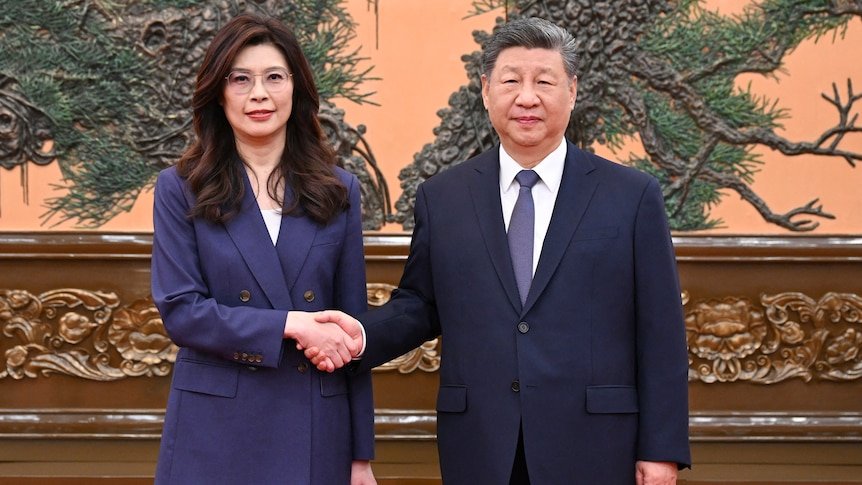
Beijing 10 April 2026
Taiwan’s opposition politics were thrust into the spotlight after Cheng Li-wun met with Xi Jinping in Beijing on April 10, 2026, a rare high-level encounter that has triggered intense debate across Taiwan over cross-strait relations and the island’s political future.
The meeting, held at the Great Hall of the People, took place during Cheng’s official visit to mainland China, which also included stops in Shanghai and Nanjing. The talks were described by Chinese state media as “constructive and forward-looking,” focusing on stability across the Taiwan Strait, shared cultural identity, and the importance of peaceful dialogue between both sides.
Cheng, a senior figure in the opposition Kuomintang (KMT), represents a political party that traditionally supports closer engagement with China compared to Taiwan’s ruling Democratic Progressive Party. The KMT has long argued that maintaining communication with Beijing is necessary to prevent escalation and preserve regional stability.
China, which claims Taiwan as part of its territory, has increasingly emphasized engagement with political actors in Taiwan who are more open to dialogue. By meeting Cheng directly, Beijing signaled its willingness to maintain and expand channels of communication with Taiwan’s opposition, even as formal ties with the current government remain strained.
The meeting comes amid ongoing tensions between Taiwan and China, with military activity and political friction continuing across the Taiwan Strait. Analysts say the timing of the encounter is significant, as it reflects Beijing’s broader strategy of using political outreach alongside diplomatic and military pressure.
Taiwan’s ruling administration, led by the Democratic Progressive Party, responded cautiously but firmly. Government officials warned that such meetings could risk undermining Taiwan’s democratic legitimacy if conducted outside official channels. They stressed that any cross-strait dialogue should reflect the democratic mandate of the Taiwanese people and be fully transparent.
Officials also reiterated Taiwan’s reliance on international partnerships, particularly with the United States, as a key counterbalance to China’s growing pressure in the region. While not directly condemning the meeting, the administration signaled concern that it could be used by Beijing for political messaging.
Public reaction within Taiwan has been sharply divided. Supporters of the meeting argue that dialogue is essential to reducing the risk of conflict and maintaining peace in the region. Some citizens expressed cautious optimism, saying that communication between political parties could help prevent misunderstandings and military escalation.
However, critics strongly opposed the engagement, accusing the opposition of giving Beijing a platform to advance its political narrative. Many fear that China may use such meetings to suggest that Taiwan is more open to political integration than it actually is, even if that does not reflect mainstream public opinion.
Social media in Taiwan quickly became a battleground of competing views, with hashtags related to the meeting trending across platforms. Younger voters, in particular, expressed skepticism, with many emphasizing a strong Taiwanese identity and resistance to political influence from Beijing. Surveys in recent years have shown a steady increase in the number of people in Taiwan who identify primarily as Taiwanese rather than Chinese, reinforcing concerns about sovereignty and political independence.
The KMT defended Cheng’s visit, stating that maintaining open communication channels with Beijing is a pragmatic necessity in managing cross-strait relations. Party representatives emphasized that dialogue does not equal concession, and argued that engagement is essential to reducing misunderstandings and preventing escalation.
Political analysts say the meeting could have long-term implications for Taiwan’s domestic political landscape, particularly ahead of future elections where China policy is expected to be a key issue. The ruling party is likely to highlight the risks of closer engagement with Beijing, while the opposition will argue that dialogue remains the most effective path to stability.
Although the meeting does not alter Taiwan’s official status, it underscores the increasingly complex dynamics of cross-strait relations. As Beijing continues its outreach and Taiwan’s internal political debate deepens, public opinion is expected to play a decisive role in shaping the island’s future direction.
Leave a Reply